
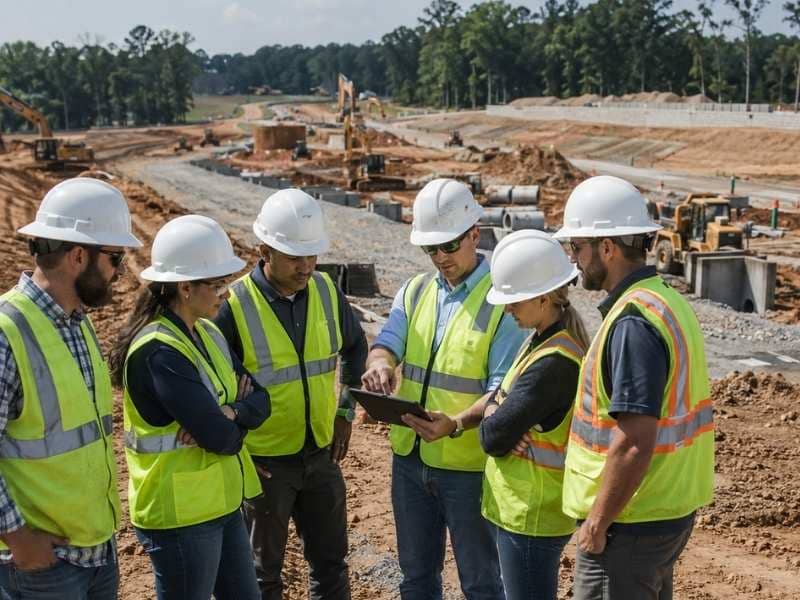
A single development can pull in a dozen different experts. Civil engineers grade the site. Geotechnical engineers test the soil. Surveyors mark boundaries. Utility designers plan water and sewer lines. Structural engineers size the buildings. Each one works on a different schedule, but the whole project only moves as fast as the slowest piece.
That’s where project management comes in. It’s not about checking boxes. It’s the glue holding every discipline together so the project doesn’t stall.
Why Multi-Discipline Coordination Is the Real Job on Large Developments
People picture a project manager tracking deadlines on a spreadsheet. On a real land development job, the work runs deeper than that.
A project manager sits at the center of several teams that rarely talk to each other directly:
- Civil engineers designing grading and drainage
- Geotechnical engineers testing soil strength
- Land surveyors setting boundaries and elevations
- Utility engineers laying out water, sewer, and stormwater lines
- Structural engineers sizing foundations and buildings
Each team hands off work to the next. A civil engineer can’t finalize a grading plan until the geotechnical report comes back. A utility engineer can’t route a sewer line until the survey confirms exact elevations. The project manager’s job is knowing who is waiting on whom, and keeping that chain moving instead of letting one team sit idle while another catches up.
On a small project, this barely matters. On a multi-acre development running five or six disciplines at once, it decides whether the job finishes on time or drags on for months.
How Project Managers Sequence Site Work So No Discipline Is Waiting on Another
Every civil project has a natural order. Skip a step and the whole schedule backs up.
Here’s a simple version of that order:
- Land survey confirms boundaries and existing conditions.
- Geotechnical testing checks soil bearing capacity and groundwater.
- Civil engineers use that data to finalize grading and drainage plans.
- Utility engineers route water, sewer, and stormwater lines around the final grading.
- Structural engineers size foundations based on soil results and final grading.
A good project manager maps this order early and builds the schedule around it, not the other way around. If the soil report runs two weeks late, the civil team can’t just be told to finish the grading plan on the old timeline. The manager has to shift the whole sequence, tell every team what changed, and reset expectations before the delay grows bigger.
This kind of sequencing sounds obvious on paper. In practice, it takes someone watching every discipline at once, because no single engineer sees all the dependencies. That’s the real function of a project manager on a multi-discipline job.
Why Charlotte-Mecklenburg Review Cycles Shape the Master Schedule
Charlotte projects don’t just move at the pace of design work. They move at the pace of local government review too.
Most land development projects in the city follow the Charlotte Land Development Standards Manual, known as the CLDSM, which sets design rules for the roads, pipes, and other public improvements the city will maintain later. Many projects also need review from Mecklenburg County’s Land Use and Environmental Services Agency, known as LUESA, for plan and plat approvals, floodplain permits, and erosion control. These reviews go through the county’s Accela online system.
None of this happens overnight. Review cycles take real time, and a plan can get sent back for revisions more than once.
A project manager who treats these reviews as an afterthought tacked onto the end of design work sets the project up for delay. The smarter approach is building review time into the schedule from day one, sending early drafts to catch major issues before the final submission, and staying in contact with the reviewing agency instead of waiting on a response.
This is one of the biggest differences between a project that finishes on time and one that drags for an extra six months. It usually comes down to whether someone planned for the review cycle or got caught off guard by it.
How One Design Revision Can Ripple Across Every Discipline on Site
Here’s something property owners rarely expect: one small change can set off a chain reaction across the whole design team.
Say a stormwater structure has to move three feet because of an unexpected utility conflict. That single shift can force:
- The drainage engineer to recheck pipe slopes and capacity
- The utility team to re-route a line that now crosses the new structure location
- The structural engineer to confirm the new spot doesn’t sit too close to a nearby foundation
- The surveyor to update staking for the revised layout
One change, four teams pulled back into the work. If nobody is tracking it, each team might revise their piece without checking the others, and the plans stop matching.
A project manager’s job here isn’t redesigning anything. It’s catching the ripple early, telling every affected team about the change the same day, and confirming the updated plans actually match before they go back out for review. Skip that step, and a small change turns into an expensive surprise once construction starts.
Why Field Coordination Between Consultants and Contractors Prevents Costly Rework
Plans look clean on paper. The ground rarely cooperates.
A pipe that fits perfectly in a drawing might hit rock that never showed up in the original soil borings. A utility line marked on a plan might sit six inches from where a contractor actually finds it. These gaps between design and reality show up during construction, not before.
Good project management means someone walks the site often, compares what’s built to what was designed, and gets the right consultant on the phone the same day a conflict turns up. Wait a week to raise a field conflict, and that’s a week of lost work, or worse, work built the wrong way that has to be torn out.
This kind of coordination is what keeps a design conflict from turning into a change order. Catching it in the field, fast, costs far less than catching it after the concrete is poured.
Frequently Asked Questions
What disciplines does a project manager typically coordinate on a land development project?
Civil engineering, geotechnical, surveying, utility design, landscape architecture, and often structural or transportation engineering. Each one produces work that feeds into the next.
How does Charlotte’s Accela review system affect project scheduling?
Plan and plat reviews, floodplain permits, and erosion control approvals for Mecklenburg County all go through Accela. A project manager treats that review window as part of the schedule, not an extra step at the end.
Why does a delay in one discipline affect the whole project timeline?
Civil engineering work runs in sequence. Utility relocation, for example, usually can’t start until survey and grading plans are locked in. A holdup in one step pushes back every step after it.
Does project management look different for site development versus vertical construction?
Yes. Site development coordination centers on earthwork, drainage, and utility sequencing before permits get pulled. Once the building phase starts, the focus shifts to coordinating trades on the vertical construction side.
How early should multi-discipline coordination start on a multi-phase development?
Before the final design is locked in. Catching a conflict, like a utility easement crossing a planned drainage structure, during preliminary design costs far less than catching it after construction drawings are done.